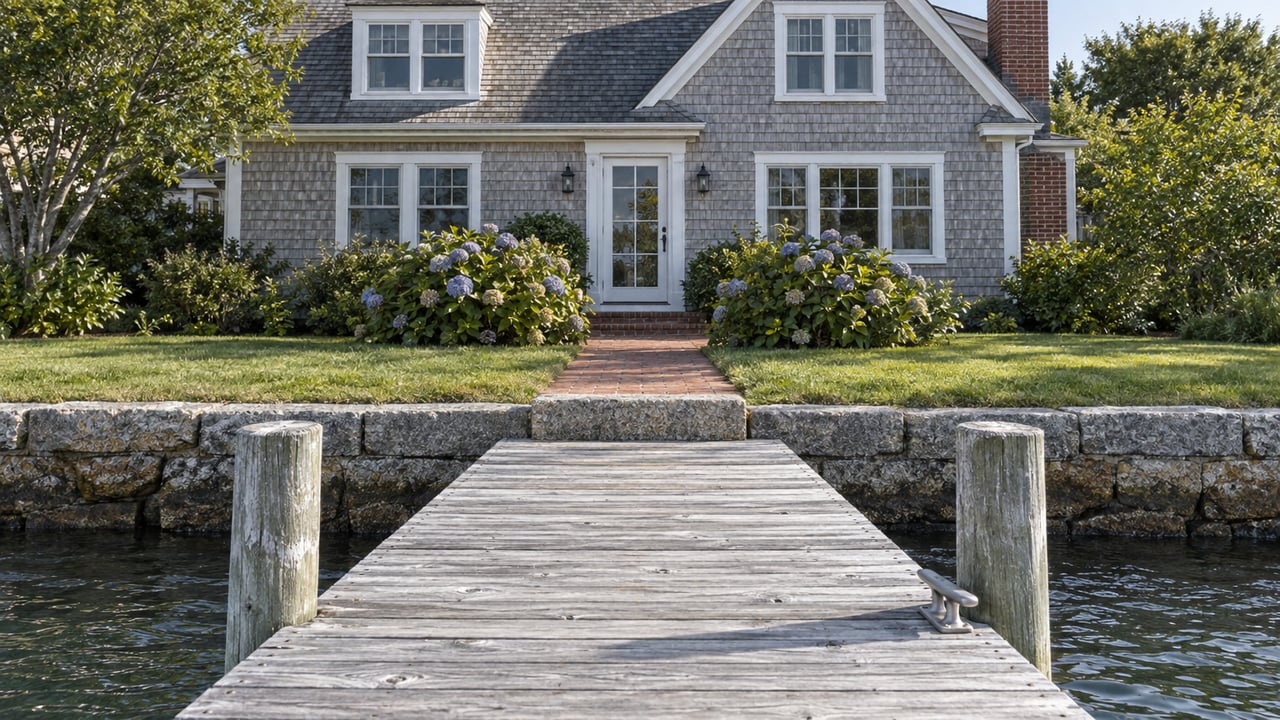
Ask a Brant Point buyer what surprised them most between attorney review and closing, and a fair number will mention the same conversation. Their closing attorney confirms that the private dock conveys with the deed, exactly as expected. Then the buyer asks about the mooring the sellers used all season, the one holding their boat a hundred feet off the lawn, and the answer isn't what they assumed. The dock is real property. The mooring is a permit. Those are two different things governed by two different systems, and only one of them changes hands automatically at closing.
This distinction rarely shows up in a listing description. It shows up in the fine print of Massachusetts waterways law and in the Town of Nantucket's own harbor code, and it matters most to exactly the buyer who assumed a waterfront address came with a guaranteed place to park a boat.
Two Permits Cover the Same Stretch of Water
A private dock, pier, or bulkhead on Nantucket Harbor typically sits under a Chapter 91 Waterways License, the state permitting system that governs any structure built in or over Massachusetts tidelands. For a small residential dock or pier, most owners qualify for what the state calls a Simplified Chapter 91 Waterways License, an expedited process available to structures under 600 square feet, whether they were built before 1984 or added later. That simplified license runs for a term of 15 years, and critically, it is treated as running with the land. Massachusetts' own permitting guide states that a Chapter 91 license is automatically transferred upon a change of ownership of the property for which the license was issued. In plain terms, if the dock is properly licensed, it comes with the house.
A mooring is a different animal entirely. Under the Town of Nantucket's harbor code, a mooring permit is defined as an annual permit issued by the Town for the placement and use of a mooring in Nantucket waterways, issued pursuant to state law under Massachusetts General Laws Chapter 91, Section 10A. That permit is tied to a person and a specific vessel, not to a parcel of real estate. The Town's own code is specific about eligibility: a vessel habitually moored in Nantucket waterways has to have its excise tax paid, and only Massachusetts-registered vessels, nonmotorized vessels, or vessels carrying a valid federal documentation certificate with Nantucket listed as the hailing port even qualify. None of that eligibility test has anything to do with who owns the waterfront lot.
So the dock structure is licensed to the property. The mooring is permitted to the person and the boat. A real estate closing transfers the first automatically and does nothing at all to the second.
What Actually Happens to the Mooring at Closing
Nothing, and that's the point. The seller's mooring permit doesn't ride along with the deed the way a fixture or an easement would. It stays a personal permit issued by the Harbormaster, renewed every year, and tied to the vessel described on that year's application. When the seller's ownership of both the house and (usually) the boat ends, so does their reason to hold that specific permit.
This isn't a small administrative detail on Nantucket Harbor specifically because demand is real. The Town's Harbormaster office maintains permitting for more than 1,800 moorings across the harbor system, working with a dozen mooring handlers who inspect and document the tackle each season, and running the Annual Town Pier Slip Lottery for the limited number of dock slips available each year. The Town's own 2023 planning notes on the Nantucket and Madaket Harbors Action Plan describe the mooring wait list candidly: it's long, though it moves faster than it used to. That single sentence, coming from the Town's own harbor planning process rather than from any sales material, is the clearest signal available that a new owner cannot assume a mooring is simply waiting for them the way the dock is.
Buyers sometimes ask whether they can simply purchase the seller's mooring permit along with the house, the way you might negotiate to keep a hot tub or a set of outdoor furniture. They can't. A mooring permit isn't the seller's asset to sell. It's the Town's assignment, and it goes back into the pool.
The Real Exception, and Why It Isn't a Free Pass
There is one legitimate shortcut, and it's worth understanding precisely because it gets oversimplified. The Town's harbor planning notes state that waterfront property owners have a right to moor in front of their own properties, a right distinct from the general public mooring waiting list. Historically, this right has actually helped relieve pressure on the harbor's mooring fields, since owners exercising it in front of their own frontage free up field moorings for everyone else.
That right is real, but it is not the same thing as inheriting a mooring the way you'd inherit a dock license. It still runs through the Harbormaster's office, still depends on the water conditions directly off that specific parcel, and still has to account for things like scope, swing radius, and whether a mooring placed there would interfere with the channel or with a neighbor's frontage. A buyer closing on a Brant Point lot can't treat the riparian right as something automatically active the day they take title. It's an application, not an inheritance.
There's a second wrinkle worth flagging for anyone comparing an older dock to a newer one. The Simplified Chapter 91 License that most small residential docks operate under runs for 15 years. A structure licensed decades ago may be approaching, or may have already passed, its renewal window by the time a new buyer takes title. The license itself transfers with ownership, but MassDEP's renewal guidance says an expired term doesn't renew itself just because the deed changed hands.
What to Confirm Before You Sign Anything
For a buyer moving from an accepted offer toward closing on Brant Point waterfront, a short list of questions to raise with the closing attorney and, where relevant, directly with the Town does more good than any generic inspection contingency:
- Is there an existing Chapter 91 license on file for the dock or pier, and if it's a Simplified License, how much of the 15-year term is left?
- Is the seller's current mooring permit issued in their name for their specific vessel, and does the seller understand that permit does not transfer to the buyer at closing?
- If the plan relies on the waterfront owner's right to moor off the property directly, has that specific parcel's eligibility actually been discussed with the Harbormaster's office, given local water depth and channel proximity?
- If the incoming buyer's boat is a different size than the seller's, does the existing mooring tackle and location even accommodate it, or would a fresh application and possibly different tackle be required regardless of any right to moor?
None of these questions are exotic. They're the kind of thing a Nantucket real estate attorney or the Massachusetts Department of Environmental Protection's Waterways Regulation Program can answer directly, and the Town's own Harbormaster's office is the authority on mooring assignments specifically. Getting the answers before closing, rather than the first week of the following summer, is the difference between a smooth first season on the water and a scramble to figure out where the boat goes.
A Few Quick Answers
Can I buy a mooring permit from the seller as part of the deal? No. Mooring permits are issued by the Town to a person for a specific vessel and are not property the seller can sell or assign to a buyer.
If I have a dock, can I just tie my boat there long-term instead of dealing with a mooring? Nantucket's harbor code treats extended use differently than a quick tie-up. Vessels using Town waterways for more than 48 hours generally need a permitted mooring rather than relying on dockside tie-up alone.
Does the waterfront owner's right to moor guarantee a spot the day I close? It gives eligible owners a path that bypasses the general waiting list, but it still requires an application to the Harbormaster and depends on the specific conditions off that property. It isn't automatic.
What happens if the dock's Chapter 91 license has lapsed by the time I buy? The license transfers with ownership if it's active, but an expired term needs its own renewal process through the state's Waterways Regulation Program, separate from the closing itself.
If you're evaluating a Brant Point waterfront property and want to understand exactly what transfers at closing and what still requires its own paperwork, Carl Lindvall has spent years walking Nantucket buyers through these details before they sign, not after.
This article is general information, not legal, tax or financial advice. Consult a qualified professional about your situation.